
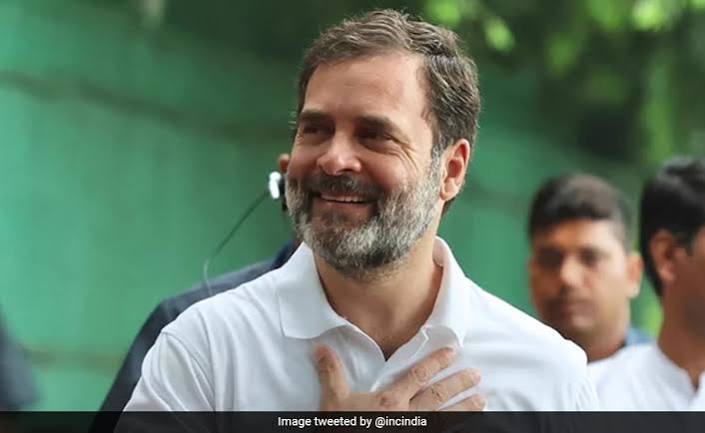
The Madhya Pradesh High Court has dropped the defamation case against Rahul Gandhi after he issued an apology
The Madhya Pradesh High Court (MPHC) has dropped a criminal defamation case against Rahul Gandhi, a first such instance to highlight the importance of reconciliation in criminal proceedings, after the Congress leader apologised for his alleged comments.The Madhya Pradesh High Court (MPHC) has disposed of a criminal defamation case against Congress leader Rahul Gandhi for expressing his remorse over the alleged remarks, marking the first such occasion. The strategy is in line with the judiciary’s desire to bring a dispute to a peaceful settlement when the complainant is pleased and the purpose of criminal law has been reasonably accomplished.
The case was filed after a criminal complaint was filed against Rahul Gandhi for allegedly defamatory comments he made during a political speech. The complainant argued the statements hurt his reputation and wanted the court to pursue a criminal prosecution. But during the proceedings, Rahul Gandhi apologised for the remarks and the matter was resolved. Bearing in mind the development, the High Court adjourned proceedings, thus terminating the litigation.
The judgment is important as it provides a practical example of the defamation law in India pertaining to criminal defamation. Defamation is defined and condemned in Section 499 & Section 500 of Indian Penal Code, 1860 (which have been largely mirrored in the Bharatiya Nyaya Sanhita, 2023). Whoever, by words spoken or written, or otherwise, makes or publishes an imputation, with the intention of causing, or knowing it to be likely to cause, injury to the reputation of another person, is guilty of defamation. Section 500 calls for imprisonment up to two years, fine or both.
Defamation is a hybrid tort and a criminal offence as it comes under both civil and criminal categories of offences. Criminal defamation is about penal consequences for protecting an individual’s reputation but civil defamation is about monetary damages for reputational harm. In Subramanian Swamy v. Union of India (2016), the Supreme Court held that the right to reputation is a part of the right to life and personal liberty guaranteed under Article 21 of the Constitution.
The High Court ruling also underscores the significance of the inherent powers granted to High Courts under Section 482 of the Code of Criminal Procedure, 1973, which has been incorporated as Section 528 of Bharatiya Nagarik Suraksha Sanhita, 2023. These provisions enable High Courts to set aside criminal proceedings for the purpose of achieving justice and stamping out the misuse of the judicial process. Where the dispute between the parties has been amicably settled and if continuation of prosecution is not of any useful purpose, such extraordinary powers may be exercised by the courts.
The expression of regret, not a formal admission of guilt, by Rahul Gandhi is crucial in the case. Many courts have held that regret or an apology has a significant role to play in resolving personal reputation disputes, where the complainant has accepted the apology and where a larger public interest is not being damaged. This will help to encourage resolution and promote restorative justice rather than extended criminal litigations.
The judgment also carries greater ramifications into political debate in India. During election campaigns, and in public debate, political leaders often criticise one another strongly. The freedom of speech guaranteed by Article 19(1)(a) of the Constitution does not cover political views but can be reasonably restricted such as defamation under Article 19(2). The case is a reminder that while vigorous political speech is protected, it must not exceed the boundaries of law and respect the reputation of individuals.
In the end, the High Court of Madhya Pradesh has ruled that criminal law cannot be used as a weapon of “extended animosity” after the conflict as such has been settled. The Court’s decision to close the proceedings after the expression of regret was motivated by the competing interests of protecting the reputation of the individual and ensuring fairness, judicial economy, and restorative justice, and was designed to strike a balance between these interests, while also reinforcing that amicable settlements can often be a better way to resolve a case than a long trial.