
The Right to Protest in India: Constitutional Protection and Legal Limits
In a constitutional democracy, the right to protest is a crucial means through which citizens express disagreement, demand accountability, and participate in public affairs. In India, although the Constitution does not expressly use the phrase “right to protest,” such a right emerges initially from the fundamental freedoms guaranteed under Article 19 of the Constitution. At the same time, this freedom is subject to reasonable restrictions intended to protect public order, sovereignty, security, and the rights of others.
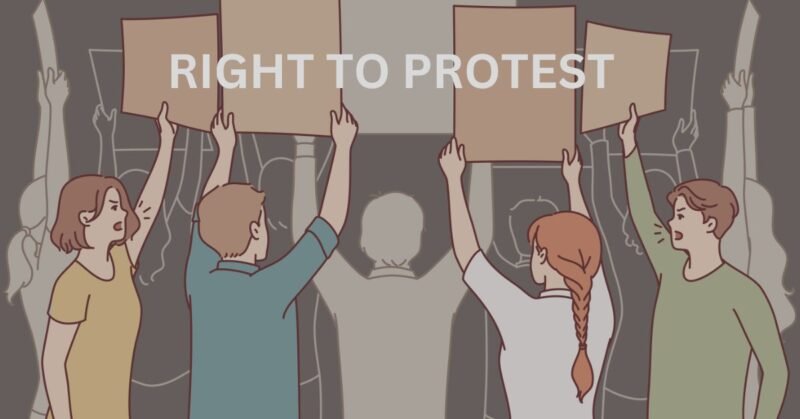
Article 19(1)(a) guarantees citizens the fundamental right to freedom of speech and expression, while Article 19(1)(b) safeguards the right to assemble peaceably and without arms. Together, these provisions provide the constitutional foundation for peaceful demonstrations, public meetings, marches, and other forms of collective expression. Protest permits citizens to communicate their concerns not merely to the government but also to society at large.
However, the right to protest is not absolute. Article 19(2) permits reasonable restrictions on freedom of speech and expression on specified grounds, including sovereignty and integrity of India, security of the State, public order, decency, morality, and other constitutionally recognised interests. Similarly, Article 19(3) allows reasonable restrictions on peaceful assembly in the interests of the sovereignty and integrity of India or public order.
The Supreme Court has repeatedly emphasised the importance of peaceful protest while recognising its limitations. In Himat Lal K. Shah v. Commissioner of Police (1973), the Court recognised that citizens have a right to assemble peacefully, while also acknowledging that the State may regulate the use of public places to maintain public peace. The decision illustrates the distinction between regulating a protest and completely eliminating the right to protest.
In Mazdoor Kisan Shakti Sangathan v. Union of India (2018), the Supreme Court considered the competing interests involved in demonstrations in public spaces. The Court recognised that public spaces cannot be occupied indefinitely in a way that protects others from exercising their rights. Thus, the rights of protesters must be balanced against the rights of residents, commuters, businesses, and other members of the public.
A significant development came in Amit Sahni v. Commissioner of Police (2020), commonly associated with the Shaheen Bagh protests. The Supreme Court held that public ways and public spaces cannot be occupied indefinitely for protests, stressing that dissent is important but must operate within the framework of law.
Therefore, Indian constitutional law attempts to maintain a balance between democratic dissent and public order. The State cannot treat every disagreement as a threat, nor can protesters claim an unrestricted right to occupy public spaces or cause violence and serious disruption.
The right to protest ultimately reflects the democratic principle that disagreement is not a weakness of democracy but an essential part of it. A constitutional democracy must provide space for peaceful dissent while ensuring that such dissent remains within lawful boundaries. The challenge lies in preserving both values: the citizen’s right to be heard and society’s right to function peacefully.