
Warning on LPG Charges: Strengthening Consumer rights in the Hospitality Industry by CCPA.
Introduction
To guard the consumer interests, the Central Consumer Protection Authority (CCPA) has threatened to take action against hotels and restaurants that charge extra fees to consumers in the name of LPG charges. The warning is given in the face of increasing criticism over the unfair imposition of hidden costs on consumers and brings up the issue of transparency and unfair trade practices within the hospitality industry.
Background and Issue
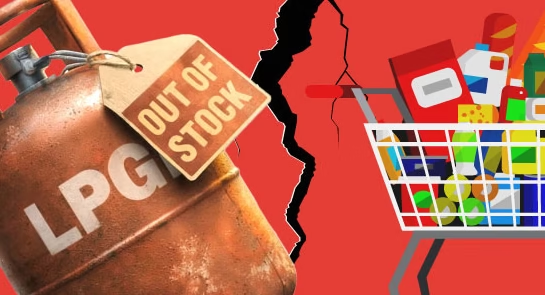
Liquefied Petroleum Gas (LPG) is a generic cost of restaurants and hotels, which is applied in cooking and food preparation. Nonetheless, there have been reports of various establishments putting a separate charge of LPG that is being charged on the bill of customers on top of the listed menu prices and applicable taxes.
The CCPA has adopted a stern position towards this practice by indicating that this type of charge is deceptive and unwarranted since the cost of running the business operations such as fuel, electricity, and wages of the staff members would be integrated in the price of food product.
Legal Framework
The act of the CCPA is founded on the Consumer Protection Act, 2019, which gives a mandate to the authority governing unfair trade practices and safeguard the rights of the consumers.
Under the Act, an unfair trade practice is:-
- Billing of services or products that are not delivered.
- Switching consumers with false information on price.
- Crying oppressed or random fees.
When the LPG charges are imposed independently on businesses, the businesses could be infringing the concept of transparent pricing; one of the principles of consumer protection law.
CCPA’s Observations
The authority has made it clear that the customers need to be charged only:
- The price listed on the menu
- Applicable taxes such as GST
- Any other fee that is not brought out clearly in the beginning or is not legally warranted may constitute an unfair practice.
The warning can be said to be in line with its previous position regarding issues of service charges whereby it has pointed out that consumers cannot be forced to pay discretionary or arbitrary charges.
Impact on Businesses
In the case of hotels and restaurants, this directive acts as a reminder so as to ensure that it observes consumer protection norms. Businesses must: –
- Do not preclude any charges which are hidden or unexplained.
- Post prices that are inclusive of all operational costs.
- Keep billing practices open.
Failure to do this would result in punishments, inquiries and even consumer law class actions.
Consumer Rights Perspective
Under the consumer perspective, the right is enhanced by the advisory to:
- Know about price of goods and services.
- Protect yourself against unfair trade practices.
- Redress redressal against exploitation.
In case a customer is faced with such charges, he or she has the option of going through consumer grieving agencies or seeking redress through consumer commissions.
Broader Implications
The intervention of the CCPA is a larger wave of increased regulation in the service economy. It is an indication that companies cannot arbitrarily transfer the cost of internal operations to the customers.
The move will also tend to encourage standard pricing ways thus leaving consumers with no surprises of being charged high bills.
Conclusion
The warning offered by Central Consumer Protection Authority is a relevant move to protect the interests of consumers in hospitality industry. The barring of the imposition of new LPG charges has strengthened the principle that prices should be fair, open and that they should include all the necessary expenses.
This development is empowering to the consumers in the sense that whatever they see on the menu is what they are supposed to pay, no more. To businesses, it acts as a guideline that they must adhere to by doing business in accordance with the law so as to enhance confidence and responsibility in business.