
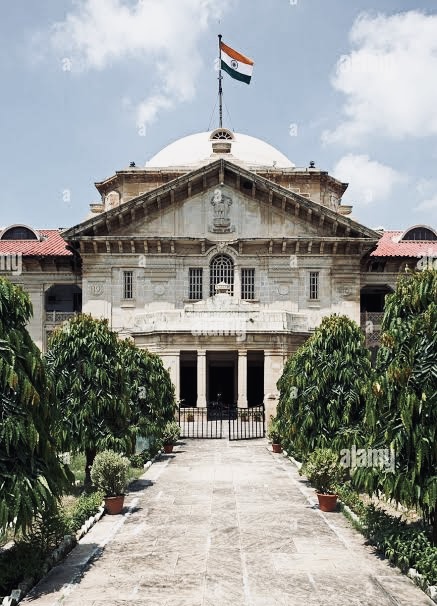
Allahabad High Court Pulls Up UP Authorities for Rejecting Muslim Man’s Conversion to Hinduism
The Allahabad High Court has strongly reprimanded the authorities of Uttar Pradesh for their action of not processing the conversion application of a Muslim seeking to convert to Hinduism. The Court noted that the State cannot be a judge of the faith of the individual and discussed the right to decide and express devotion to a religion as guaranteed by the Constitution of India.
The case came to light when a Muslim man had sought conversion to Hinduism under the Uttar Pradesh Prohibition of Unlawful Conversion of Religion Act, 2021. But, it was alleged that the process was being rejected or obstructed by local authorities with no proper legal reasons. The petitioner then filed a writ petition with the High Court, alleging infringement on his fundamental rights, as guaranteed by Articles 21 and 25 of the Indian Constitution.
The Court’s questioning of the authorities during the proceedings was sharp, and commented on the fact that the freedom of conscience and belief of individuals cannot be stopped just because the administration is suspicious of the conversion. The bench emphasized that the Constitution provides each and every individual the right of choice, change and practice a religion of his liking, “unless the conversion is induced by any form of compulsion, fraud or inducement”.
The Constitution provides for the freedom of conscience and the right freely to profess, practice and propagate religion in Article 25. The SC has consistently interpreted this as an integral of individual autonomy and dignity. The Allahabad High Court confirmed that the responsibility of the State in the context of anti-conversion laws is not to stop people from making conversions based on their faith but to prevent illegal or forced conversions.
The judgment is important because it comes in the backdrop of increasing concerns about the implementation of the anti-conversion laws in several states. There have been several instances of the misuse of such laws, and it has been argued that they will contravene personal liberty, particularly in interfaith relations. The Court’s observations emphasize that the illegality must not be presumed for those who are members of one religion who desire to change to another one.
The Court also pointed out the general rule of the Constitution of Pakistan which allows the state to be neutral in religious matters. In India, the secular system does not allow the government to rule on the validity of a citizen’s religious convictions, unless there is a clear case of illegal activities. In this context, the High Court restated that the realm of personal faith is a private one of the individual.
The decision could be of significance in the future for other pending cases regarding the issue of religious conversion in Uttar Pradesh and elsewhere. It is a reminder to be careful and act in accordance with constitutional protections in terms of anti-conversion laws. The judgment will also add to the jurisprudence on decisional autonomy, privacy and dignity, which have been increasingly important in Indian constitutional law, following the seminal cases like Justice KS Puttaswamy’s case v. Union of India.
At the end, the intervention of Allahabad High Court confirms the notion of freedom of religion and freedom to change religion. The Court gave a clear signal that constitutional rights not to be subjected to administrative suspicion or ideological viewpoints. The ruling is a significant affirmation of religious freedom and personal decision in a democratic form of government.