

Controlling Faith or Limiting Choice? A Legal Discussion of the Maharashtra Freedom of Religion Act, 2026.
Introduction
The introduction of the Maharashtra Freedom of Religion Act, 2026 is the start of a new change in the progressive nature of religious freedoms legislation in India. Placed as an action to prevent illegal religious conversions, the law has brought the controversy on the right of individual freedom and the control of the government on the basis of the Constitution of India.
Legislation and Legislative Aim
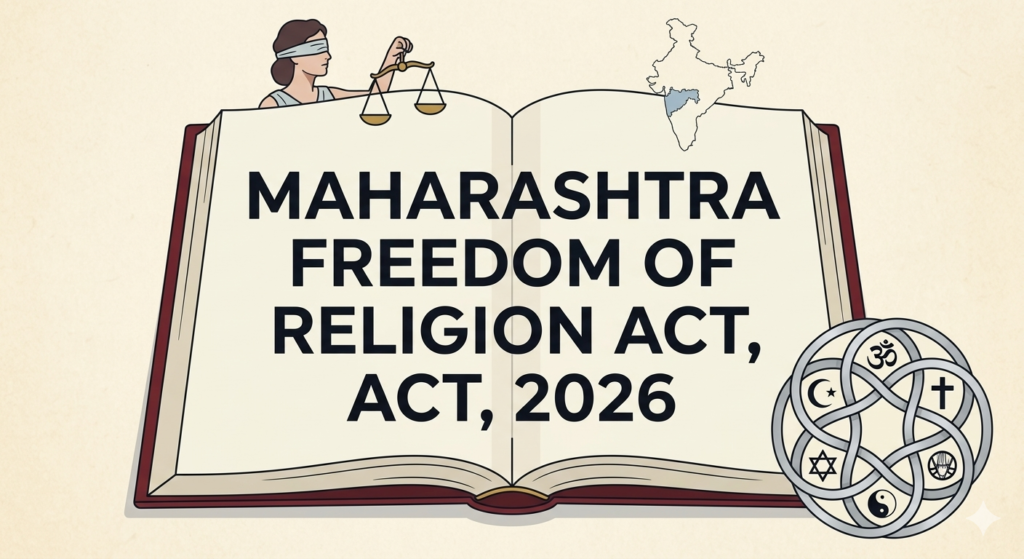
The Act is based on an increasing trend of the Indian states to regulate religious conversions, the ones, which are said to be done through force, fraud, or by means of enticement. Similar laws have been passed in states like Uttar Pradesh and Madhya Pradesh in the recent years. The Maharashtra law is a meant to offer a legal structure to probe and punish conversions that are not valid, whereas it is purported to protect the free will of religion.
Essentially, the law aims to ban conversions obtained through coercion, misrepresentation, undue influence or material inducement. It also brings in procedural protection as in the form of prior intimation to the district authorities before conversion ceremonies and post conversion declarations.
Material Provisions and Mechanisms
The Act has been characterized by a mandatory declaration by persons who have intended to convert in the presence of an authorized person, usually, the District Magistrate. Priests or other people leading the conversion process of the religion might also be expected to give prior notice. The lack of compliance may bring about punitive measures
The Act also criminalizes conversions of minors and women as well as members of marginalized communities under aggravated categories, giving them heavier penalties. It also enables family members or other related individuals to complain broadening the scope of individuals who could initiate a legal proceeding.
Although these provisions are premised as protectionist, they create concerns of the intricacy of the process and the degree to which the state encroaches on the belief system of individuals.
Constitutional Tensions
The main constitutional debate of the Act is the way it frames the Article 25 of the Constitution which affirms the freedom of conscience and the right to freely profess, practice and propagate religion. However, this right is open to the order, morality, and health of the people.
In the Supreme Court case, Rev. Stainislaus v. State of Madhya Pradesh, 1977 the Supreme Court affirmed the validity of anti-conversion laws, and determined that the right to propagate did not confine to right to convert another individual by force or fraud. This precedent is a source of legitimacy of the Maharashtra Act.
But, modern constitutional rhetoric has broadened interpretation of personal freedom in Article 21 especially on issues of individual choice, dignity and privacy. Court cases that acknowledged the right to select a partner and religion indicate that the state can face constitutional challenges due to overchoice.
Concerns and Critiques
Critics consider that the Act can lead to the chilling effect of actual, voluntary conversion through straining procedural requirements. The inclusion of government into such a personal issue of belief casts doubt upon an issue of spying and abuse.
Also, the generalized meaning of allurement and undue influence can result in bias in its interpretation, making it more likely to be implemented arbitrarily. The law is also feared to have skewed effects on relationships between different religions and minority groups.
Conclusion
The Maharashtra Freedom of Religion Act, 2026 is a multifaceted blend of the liberty of religion, state control, and personal agency. Though as much as its stated purpose of avoiding coercive conversions is constitutionally valid, its method used must pass the test of proportionality and fundamental rights.
Finally, the Act will be legitimized based on the implementation and the judicial review. There should be a delicate balance; a balance that will keep people not exploited at the same time as not undermining their freedom of conscience. In the pluralistic democracy such as inIndia, the real test of such a legislation is not only its intent, but also its capability to maintain both liberty and diversity to the same degree.